We often treat sleep like an off switch at the end of a busy day—a passive state we slip into once our to-do list is finally cleared. But biochemically, sleep is far from passive. It is an active, highly regulated biological process governed by your Central Nervous System (CNS).
If you find yourself tossing and turning, waking up at 3:00 am with a racing mind, or feeling exhausted even after eight hours in bed, the issue often isn’t just “poor sleep hygiene”. It is an overactive nervous system that simply doesn’t feel safe enough to downshift.
The Nervous System and the Sleep Engine
Your Central Nervous System—comprising the brain and spinal cord—acts as the master control unit for your body’s sleep-wake cycle. Within the Autonomic Nervous System (ANS), two primary branches dictate your state of arousal:
- The Sympathetic Nervous System (SNS): Your physiological “accelerator”. It drives the fight-or-flight response, preparing your body to react to danger.
- The Parasympathetic Nervous System (PNS): Your physiological “brake pedal”. Often called the “rest and digest” mode, it slows the heart rate, lowers blood pressure, and initiates cellular repair.
For sleep to occur—and for that sleep to be deep and restorative—your body must shift out of sympathetic dominance and allow the parasympathetic nervous system to take the wheel.
Modern Life & The “Wired and Tired” Cycle
In ancestral times, the sympathetic nervous system turned on for immediate threats—like running from a predator—and turned off once the danger passed.
Today, modern life keeps the sympathetic accelerator permanently pressed to the floor. Constant screen time, late-night work emails, financial stress, traffic, and endless notifications trick the brain into sensing continuous threat.
When your brain perceives stress, it signals the Hypothalamic–Pituitary–Adrenal (HPA) axis to dump stress hormones into your bloodstream:
- Adrenaline: Increases heart rate, blood pressure, and alertness.
- Cortisol: Your primary stress hormone, designed to keep glucose flowing for quick energy.
In a natural circadian rhythm, cortisol spikes in the morning to wake you up and tapers off dramatically by evening, allowing melatonin (your sleep hormone) to rise. Modern chronic stress flips this curve. Elevated nighttime cortisol suppresses melatonin, keeping your heart rate elevated and your mind in a state of hyper-vigilance. You end up feeling simultaneously exhausted and unable to wind down—the classic “wired and tired” state.
How Our Clinic Modalities Help Reset Your Nervous System
While lifestyle adjustments are essential, breaking a chronic sympathetic loop often requires direct, physical intervention to retrain the nervous system. In our practice, we combine three synergistic modalities to help shift your body back into balance:
1. Chiropractic Care: Restoring Signal Clarity & Vagal Tone
Spinal misalignments and joint dysfunction place mechanical stress on surrounding tissues, sending a constant stream of irritation signals to the brain. This keeps the CNS in a state of low-grade alert.
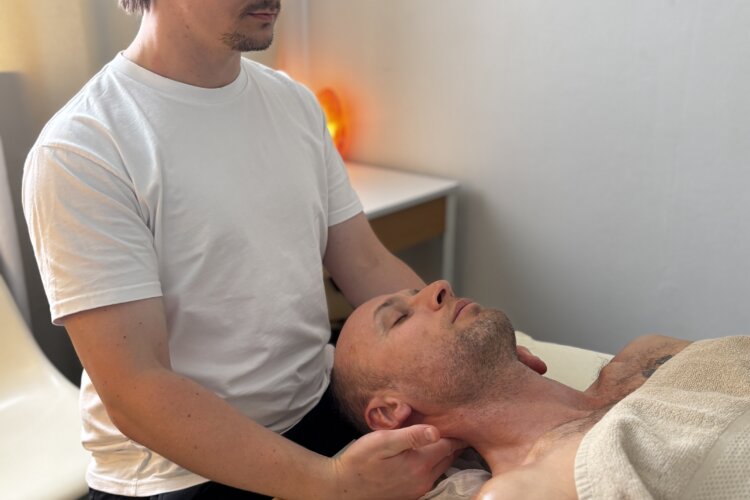
Targeted chiropractic adjustments reduce nerve irritation and restore proper spinal motion. Crucially, adjustments—particularly around the upper cervical spine—stimulate the vagus nerve, the central highway of your parasympathetic nervous system. By strengthening vagal tone, chiropractic care acts like tapping the brake pedal, helping lower sympathetic drive and encouraging natural sleep cycles.
2. Therapeutic Massage: Breaking the Physical Stress Loop
When you live under chronic stress, your muscles retain constant tension. This physical tightness continuously signals to the brain that you are under threat, reinforcing the stress response.
Therapeutic massage interrupts this cycle. By physically manipulating soft tissue and stimulating nerve receptors in the skin and muscle, massage therapy lowers heart rate, reduces sympathetic nervous activity, and lowers systemic cortisol levels. At the same time, it promotes the release of serotonin and dopamine—neurotransmitters vital for mood stability and melatonin synthesis.
3. Acupuncture: Calming the Central Stress Axis
Acupuncture works directly on the neuroendocrine system. By placing ultra-fine needles at specific clinical points, acupuncture works by signalling through the central nervous system to quiet an overactive HPA axis.
Research shows that acupuncture can measurably reduce elevated cortisol levels, boost endorphins, and stimulate the parasympathetic nervous system. This systemic “dimmer switch” helps quiet racing thoughts, ease physical tension, and signal to the brain that it is safe to transition into deep, slow-wave sleep.
Daily Practices to Support Restorative Rest
Alongside hands-on therapy, small daily habits can help maintain nervous system balance:
- Create a 60-Minute Screen Buffer: Turn off smartphones, laptops, and TVs an hour before bed. The blue light from screens suppresses melatonin production and keeps the sympathetic system engaged.
- Practise Vagal Breathing: Spend 5 minutes doing “box breathing” (inhale for 4 seconds, hold for 4, exhale for 4, hold for 4) or prolonged exhales (4-second inhale, 6-second exhale) to manually stimulate the parasympathetic response.
- Anchor Your Circadian Rhythm: Get 10–15 minutes of direct sunlight in your eyes shortly after waking. This sets your biological clock and ensures melatonin production begins at the right time that evening.
- Release Muscle Tension Before Bed: Light stretching or a warm shower raises core body temperature slightly, followed by a rapid cooling effect that tells the brain it is time to sleep.
Ready to Reset Your Nervous System?
True rest isn’t something you force—it’s something your body naturally slides into when your nervous system feels balanced and supported. If you’ve been struggling to get the deep, rejuvenating sleep you need, our team is here to help you address the root cause. Contact our clinic today to schedule an evaluation and discover how a personalised combination of chiropractic care, massage, and acupuncture can help you get back to restful nights.